Thursday, June 18, 2009

First Family gets some new art


The Obamas have borrowed Ed Ruscha's "I Think I'll..." (1983) from the National Gallery


President Barack and First Lady Michelle Obama are shaking things up in D.C. in more ways than one. Besides being the first black Presidential family, the Obamas are changing out the artwork in the White House.

Currently, the White House is full of Hudson River School paintings, landscapes, and the like. The Obamas, supporters of the arts, are actively seeking out modern and contemporary work made by women, Latinos, Asian, and African-American artists. It is said that they have a "wish list" of about 40 artists that they would like to see in their home, and are contacting museums and galleries to borrow the work.

Read more about the Obama artwork shakeup:
Changing the Art on the White House Walls from The Wall Street Journal
• Listen to "Yes We Can Be More Artistically Inclusive" from WNYC's The Brian Lehrer Show

Thursday, June 11, 2009

First photographs


Although people were experimenting with primitive photography techniques, pin-hole cameras, camera obscuras, etc. for centuries, the first permanent photograph is said to have been created around 1825 by Nicéphore Niépce. Niépce referred to this type of images as heliographs (sun writings). Using a plate coated in bitumen, he exposed the plated with a camera obscura over an 8-hour period. After he washed the plate with lavender oil, the View from the Window at Le Gras appeared.


Currently, the original plate is on display at the Harry Ransom Humanities Research Center, at the University of Texas at Austin.

Tuesday, June 9, 2009

First Oil Paintings


Just last year scientists discovered what are being described as the world's first-ever oil paintings. Much like the Lascaux paintings, these were found on caves, however in Afghanistan. The findings prove that oils had been used in Asia hundreds of years earlier than in Europe.


From CNN:
Scientists found the murals in a network of caves where monks lived and prayed in the Afghan region of Bamiyan, according to a statement on the Web site of the European Synchrotron Radiation Facility, where the ancient paintings were analyzed.

Until 2001, two colossal 6th-century statues of Buddhas stood at the mouth of the caves. Then the Taliban, which then ruled Afghanistan, blew up the statues on the grounds that they were un-Islamic. The action drew international condemnation.

Inside the caves, scientists found murals painted in the 7th century. They show images of Buddha in vermilion robes sitting cross-legged amid palm leaves and mythical creatures.

In 12 of 50 caves, the murals were painted using drying oils -- perhaps from walnuts and poppy seeds -- the European Synchrotron Radiation Facility said.

Its findings on the age of the oil paintings were published this week in The Journal of Analytical Atomic Spectrometry.

"This is the earliest clear example of oil paintings in the world," said Yoko Taniguchi, leader of the team of scientists.

keep reading about the first oil paintings...

Wednesday, June 3, 2009

our first space artist


This summer, 40 years after Neil Armstrong walked his first steps on the moon, "space artist" Alan Bean will exhibit a group of his paintings in a show entitled Alan Bean: Painting Apollo, First Artist on Another World at the Smithsonian National Air and Space Museum.

Alan Bean was the fourth man to walk on the Moon in 1969 (with Apollo 12). After working with NASA for 18 years as an astronaut, Bean retired so that he could focus on his painting.

The Smithsonian, heralding Bean as the first "space artist", says, "Displaying both art and artifacts, this exhibition weaves the technology of one of humankind’s greatest achievements with an artist’s firsthand account of a new frontier."

Opening Thursday, July 16, 2009
Smithsonian National Air and Space Museum
The National Mall
Independence Ave at 6th Street, SW
Washington, DC 20560

Tiptoeing on the Ocean of Storms, 1982, acrylic on masonite


Kissing the Earth, 1994, acrylic on masonite

Friday, May 29, 2009

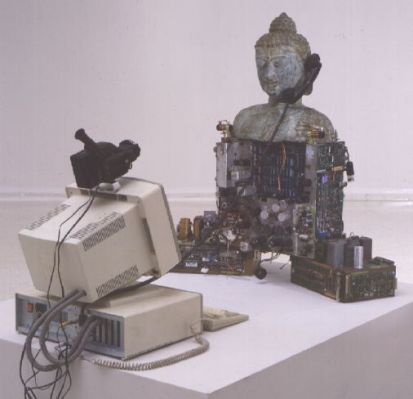
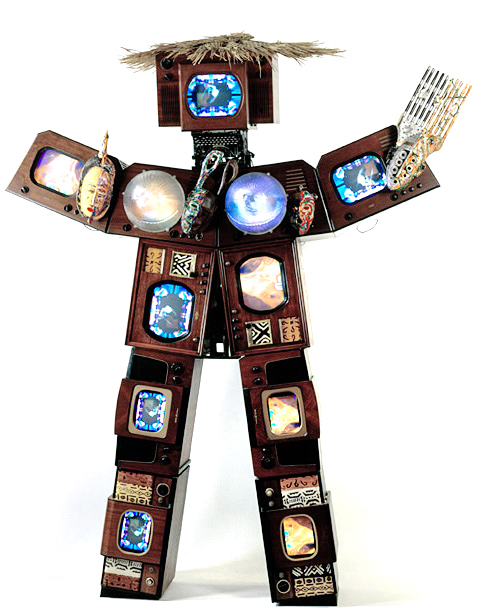
Nam June Paik

Nam June Paik is considered to be the world's first video artist, as well as the first video artist to break many boundaries.

Born in South Korea in 1932, Paik was an American artist working from the 1960s until his death in 2006. A participant in Fluxus as well, Paik's contribution to the art world and to future generations is unparalleled.

Visit the official website here

A video about Paik:


Some images of his work:


Thursday, May 21, 2009

thanks goodness for gutenberg!


The Gutenberg Bible is widely considered to be the first book ever printed using a printing press (it is not the very first, but the first major work). Completed in the fifteenth century (1455) by Johannes Gutenberg in Mainz, Germany, the book is also referred to as the Mazarin Bible. Currently, there are 48 Gutenberg Bibles (of the 42-line variety) in existence in the world, with eleven of them in the United States.

Each copy of the Gutenberg is unique, due to the hand work it took to complete the illuminations of the books. The illuminated manuscripts are quite beautiful (I have spent quite a lot of time with one of them), and the colors are remarkably still vibrant.

Because of Gutenberg's work, books were now widely distributable and easier to acquire, beginning the "Age of the Printed Book."

Friday, May 15, 2009

Sadie Benning at the Whitney


The Whitney Museum of American Art's first floor gallery is currently home to Sadie Benning's stop-animation Play Pause. Benning was first shown at the Whitney in 1993 at the biennial, when she was only 20, and once again at the 2000 biennial.

Benning, aside from being a former member and cofounder of the band Le Tigre, is most known for her films. As a young girl growing up in Milwaukee, she was given a gift by her father (experimental filmmaker James Benning) - a Fischer-Price PXL-2000 - the PixelVision. She began recording herself and making short films concerning adolescence and sexual identity. She continued to use the PixelVision at times, even when other cameras became available to her, as her signature style - as it added a sense of authenticity and grittiness to the shots.

Her current show at the Whitney marks her 3rd time at the Whitney, as she returns to the site of her 1st Biennial.

Benning has received grants and fellowships from Guggenheim Foundation, Andrea Frank Foundation, National Endowment of the Arts, and Rockefeller Foundation. Awards include Wexner Center Residency Award in Media Arts, National Alliance for Media Arts & Culture Merit Award, Grande video Kunst Award, and the Los Angeles Film Critics Circle Award. She received her M.F.A. from Bard College. Her videos are distributed by Video Data Bank.